


In this guide 7
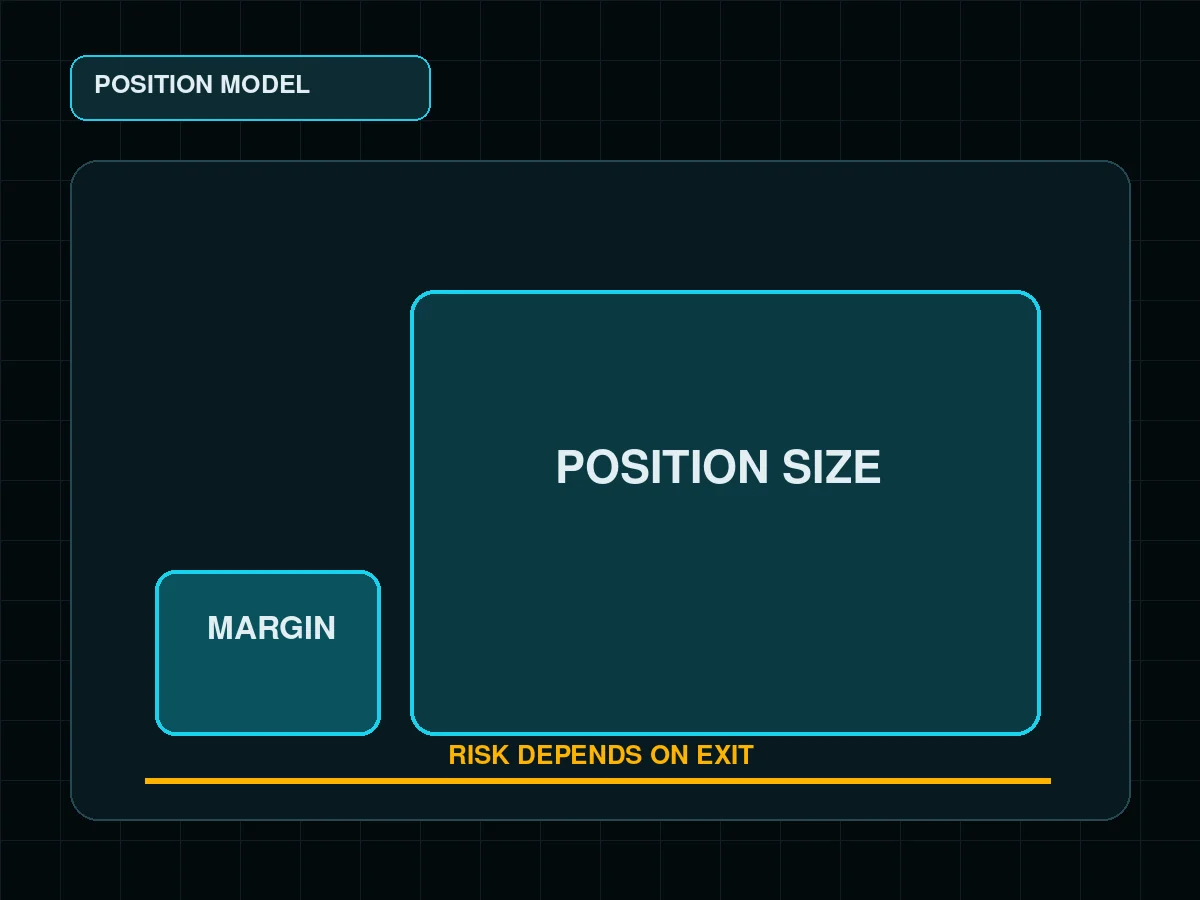
Margin is collateral committed to a leveraged position. Leverage describes how large the position is relative to that collateral or to account equity. Neither number tells you the planned loss by itself.
The clean sequence is: choose an invalidation price, choose the cash loss you accept, calculate position size, then check how much margin and liquidation room the leverage setting creates.
01Four connected numbers#
Leverage = Position size / Margin
Margin = Position size / Leverage
Profit or loss = Position size x Price change
Risk at stop = Position size x Stop distance
An illustrative $5,000 position at 5x uses $1,000 of initial margin. If price moves 2%, represented by a 0.02 fraction, against the position, the loss is about $100 before fees and funding. It is 2% of the position and 10% of the margin.
In the same illustrative model, at 10x the $5,000 position uses $500 of margin. The same 2% move still loses about $100. The multiplier changed the collateral, not the dollar sensitivity of the unchanged position.
Another illustrative model keeps margin fixed: a $1,000 allocation at 10x creates a $10,000 position. A 2% or 0.02 move now loses about $200.
02Position size should come from risk#
Assume an illustrative account of $10,000, planned risk of 1% or a 0.01 fraction, equal to $100, and a stop 4% or 0.04 away.
Position size = $100 / 0.04 = $2,500
In this illustrative account model, at 2x the $2,500 position needs $1,250 margin; at 5x it needs $500; and at 10x it needs $250. The stop still loses about $100 before costs because the position stays $2,500.
Illustrative cost model: assume a 4% stop plus 0.1% round-trip costs, equal to a 4.1% or 0.041 denominator. Dividing the $100 loss budget by 0.041 gives a position near $2,439.
03Equity and available margin#
Account equity changes with unrealized profit and loss. Available margin is the part not already committed or reserved. Several positions can appear individually small while their combined risk is large, especially when they move together.
Track at least:
- total account equity;
- margin committed to open positions;
- cash loss at every stop;
- combined loss if correlated stops are hit;
- distance from each stop to the venue's liquidation estimate.
The margin percentage displayed by a platform is an operational warning. It is not a replacement for a stop-based risk plan.
04Liquidation is not a stop loss#
Liquidation protects the lender or venue from an account deficit. Its estimate depends on maintenance margin, fees, position mode and other open positions. It can move as equity changes.
A planned stop should normally sit well before liquidation. If the liquidation estimate is inside or close to the logical stop, the leverage is too high for that position structure. Reducing position size is usually clearer than trying to place the stop where the leverage permits.
05Stocks and derivatives use different implementations#
In a securities margin account, the broker lends money against assets in the account and may require additional equity or sell positions when requirements are not met. FINRA warns that margin trading can produce losses beyond the original investment and that firms can impose requirements above regulatory minimums.
Crypto derivatives often express leverage as a multiplier and use isolated or cross margin. The labels differ, but the core relationship is the same: borrowed exposure makes the position larger than the collateral supporting it.
06Checklist before increasing leverage#
- Keep position size fixed and compare only the margin requirement.
- Confirm the cash loss at the planned stop.
- Include fees and, for perpetual contracts, possible funding.
- Check the liquidation estimate after all open positions are included.
- Ask what happens during a gap or fast move beyond the stop.
- Consider isolated margin when a clear collateral boundary fits the plan, after checking the venue's rules.
Borrowed exposure is a financing parameter, not an edge. The trade's risk comes from position size, price movement and execution. Calculate those first. The position-size calculator starts from the loss budget; isolated versus cross collateral explains how funds can be shared; and the crypto multiplier guide covers the broader product mechanics.
Treat the venue's displayed liquidation figure as an estimate tied to its current rules and account state. Recheck it after changing size, collateral, position mode or other open positions. A worked risk budget remains useful even when the displayed estimate moves.
Primary source checked November 5, 2026: FINRA guide to frequent intraday trading and margin risk.
FAQ#
Is margin the same as leverage?
Does higher leverage change the loss on an unchanged position?
Why is liquidation not a stop loss?

DoberInvest on Telegram
Questions about this guide?Ask in the English channel. That is also where we post charts, the levels we watch and what would change our mind. A system, not signals, and no profit promises.
This guide explains how the mechanics work; what you do with them is your own decision. Trading can lose you money, and leverage makes losses bigger and faster. 18+

AI-assisted editorial draft prepared and fact-checked against the cited sources; published by the DoberInvest editorial team, not as Konstantin Shulga's personal experience.