


In this guide 7
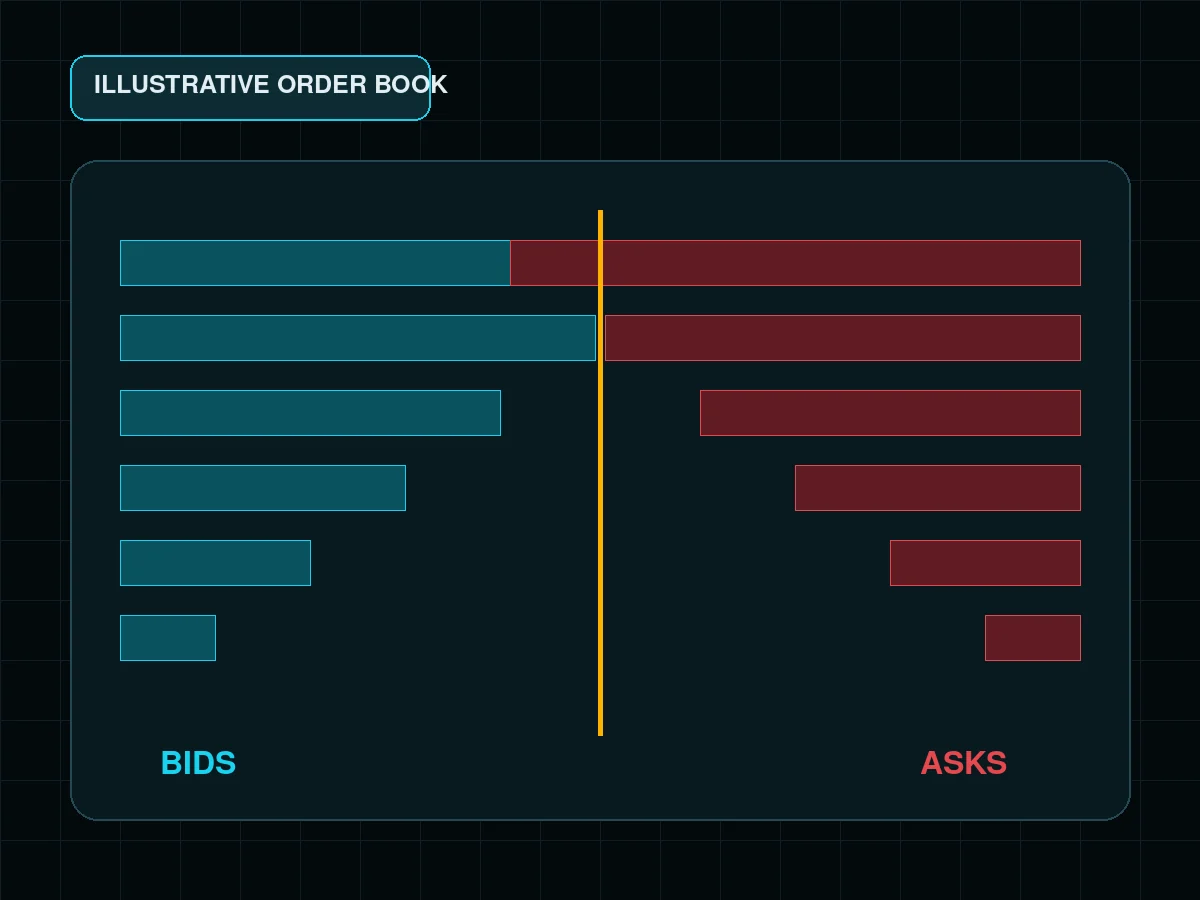
An order book is a list of resting buy orders, called bids, and sell orders, called asks. The highest bid and lowest ask form the top of the book. Their difference is the spread. Depth is the quantity available beyond those first prices.
The last traded price is history. A market order interacts with the orders available now, so the book matters more than the last print when estimating execution.
01A small order-book example#
Assume this illustrative ask side for a token: 2 units at $100.00, 3 at $100.20, 5 at $100.50 and 10 at $101.00.
| Ask price | Quantity | Cumulative quantity |
|---|---|---|
| $100.00 | 2 | 2 |
| $100.20 | 3 | 5 |
| $100.50 | 5 | 10 |
| $101.00 | 10 | 20 |
A market buy for one token fills at about $100. A market buy for eight tokens consumes 2 at $100, 3 at $100.20 and 3 at $100.50. In this illustrative book, those three legs cost $200.00, $300.60 and $301.50.
Cost = (2 multiplied by 100) + (3 multiplied by 100.20) + (3 multiplied by 100.50) = $802.10
Average fill = $802.10 / 8 = $100.2625
If $100 was the best ask when the order was sent, the average-fill difference is $0.2625 and execution slippage is 0.2625%. Fees are separate. A chart may still display a price near $100 while the large order's average fill is higher.
02Spread and depth answer different questions#
A narrow spread says the first bid and ask are close. It does not say much quantity is available there. A book can show a one-cent spread with only a tiny order at each top level.
Depth asks how much can trade before price moves by a chosen amount. Illustrative comparison bands might be 0.1%, 0.5% and 1% from the midpoint; they are user-selected model inputs, not universal thresholds. A comparison only makes sense for the same market and at roughly the same time.
03Market order, limit order and partial fill#
Coinbase describes a market order as an instruction to execute immediately at the best available prices. It may fill at several prices and does not lock one displayed price. A limit buy sets the maximum price the trader accepts. It controls price, but it may remain unfilled.
Illustrative limit-order model: assume the 8-token buyer uses a limit of $100.20. The order can buy the first 5 tokens but cannot cross the $100.50 level. The result may be a 5-token partial fill with 3 tokens still open or cancelled, depending on the execution instruction.
This is not an error. Price control and certainty of completion are competing goals.
04The book moves while you read it#
Displayed orders can be added, cancelled or filled before your order arrives. During fast markets, a screenshot is stale almost immediately. Some venues also protect market orders by stopping execution beyond a configured distance, which can leave a partial fill.
Use the book as an estimate, not a promise. The final fill report is the source for average price, fees and quantity.
05A pre-trade check#
- Record the best bid, best ask and midpoint.
- Enter the intended quantity, not only its cash value.
- Sum asks for a buy or bids for a sell until the quantity is covered.
- Calculate the weighted average price.
- Add the fee shown in the order preview.
- Decide whether price certainty or immediate completion matters more.
- Reduce size or split the order if estimated impact is too large.
Splitting an order can reduce the impact of one immediate trade, but a better result is not certain. Price may move between parts, and multiple fees or minimum order sizes may apply.
06Common reading errors#
- Treating the last price as an executable quote.
- Looking only at the top line and ignoring cumulative quantity.
- Comparing depth on different venues without matching quote currency.
- Forgetting that a sell consumes bids, not asks.
- Calling every difference between expected and average fill a fee.
- Assuming a limit order must fill because the chart touched its price.
An order book is a map of current intentions. A fill is a completed transaction. Keeping those two ideas separate makes slippage and partial fills easier to explain and measure. The bid-ask spread page covers the first price level, while limit versus market orders covers order choice; this article focuses on cumulative depth and weighted fills.
Primary sources checked November 5, 2026: Coinbase Advanced order types, Coinbase order management, and Coinbase order execution policy.
FAQ#
What does order book depth measure?
Why can a market order fill at several prices?
Can a limit order be partially filled?

DoberInvest on Telegram
Questions about this guide?Ask in the English channel. That is also where we post charts, the levels we watch and what would change our mind. A system, not signals, and no profit promises.
This guide explains how the mechanics work; what you do with them is your own decision. Trading can lose you money, and leverage makes losses bigger and faster. 18+

AI-assisted editorial draft prepared and fact-checked against the cited sources; published by the DoberInvest editorial team, not as Konstantin Shulga's personal experience.