


In this guide 10
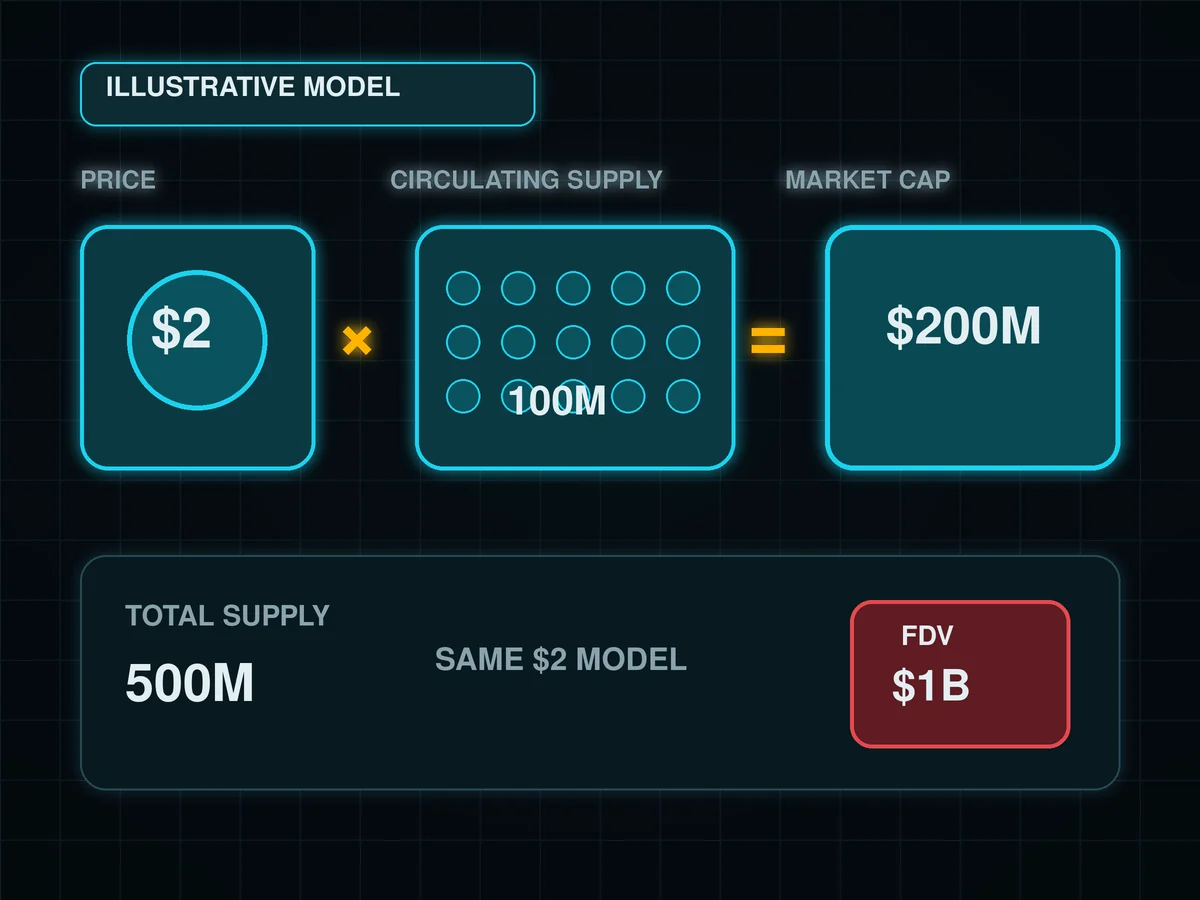
Crypto market cap is current price multiplied by circulating supply. If a token trades at $2 and 100 million tokens are circulating, its market capitalization is $200 million.
The formula is useful for comparing relative size. It is also easy to overread. Market cap is not the cash invested in a project, not the amount holders could withdraw at the current price, and not a score for technology or safety. It is a valuation built from one price estimate and one supply estimate.
This guide shows how the number is constructed, why data providers disagree, how fully diluted valuation changes the picture, and which extra checks matter before comparing two assets.
01The formula#
Market cap = reference price multiplied by circulating supply
CoinMarketCap and CoinGecko both publish this formula in their methodologies. The difficult part is not multiplication. It is deciding which price represents a fragmented market and which tokens are genuinely circulating.
Price can come from many trading pairs across many exchanges. A data provider filters unreliable pairs and combines the remaining observations into a reference price. Circulating supply attempts to exclude tokens that are locked or otherwise unavailable to the public. Different filters and supply classifications can produce different answers without either site making an arithmetic mistake.
02A worked token example#
Consider an illustrative token called NORTH. These are invented numbers for learning, not live market data.
| Input | Value |
|---|---|
| Reference price | $2.00 |
| Circulating supply | 100 million NORTH |
| Total supply | 500 million NORTH |
| 24-hour trading volume | $1.5 million |
The current market cap is $2 multiplied by 100 million = $200 million.
The fully diluted valuation is $2 multiplied by 500 million = $1,000 million ($1 billion). The 100 million circulating supply divided by 500 million total supply is 20%. The 500 million total supply is 5 times the 100 million circulating supply, so the FDV is 5 times the market cap.
Now assume 50 million locked tokens unlock while the reference price remains $2. Circulating supply becomes 150 million and market cap becomes $300 million. The displayed market cap rose by $100 million, but that does not prove $100 million of new cash entered. The formula changed because the circulating-supply input changed.
The same caution applies when price moves. If a small final trade lifts the reference price from $2.00 to $2.10, the formula marks all 100 million circulating tokens at $2.10. That implies a $210 million market cap, up from $200 million. Market cap rises by $10 million even though the trade itself may have been tiny.
03Market cap is not money invested#
This is the most important distinction. A market is a sequence of marginal trades. The latest accepted price is applied to every circulating unit, including tokens that did not trade.
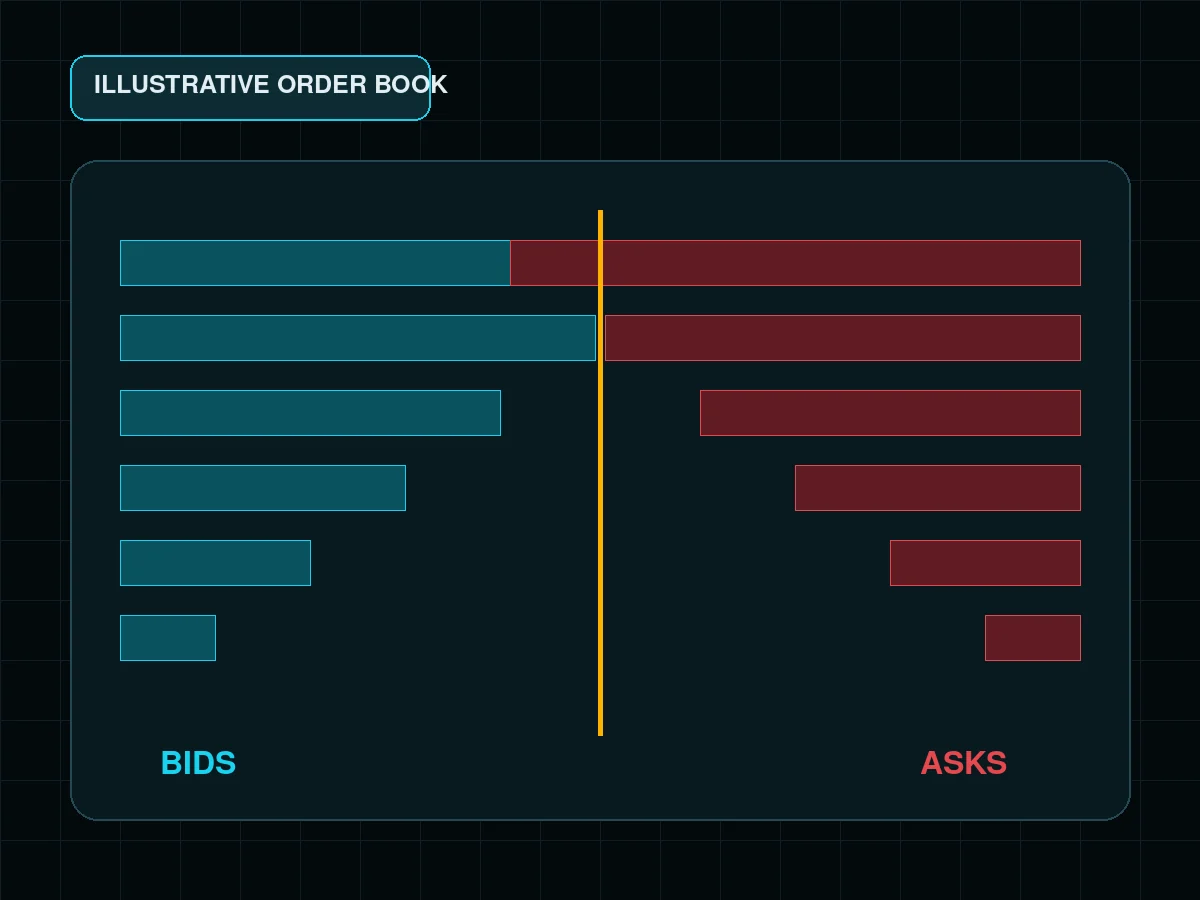
Imagine NORTH has asks at progressively higher prices:
| Available to buy | Ask price |
|---|---|
| 25,000 tokens | $2.00 |
| next 50,000 | $2.05 |
| next 100,000 | $2.20 |
A buyer cannot purchase 175,000 tokens at the displayed $2 price. The order moves through the book and pays more for later units. Selling a large holding works in reverse. This is why market cap and liquidity must be examined separately.
Our guide to limit and market orders explains why an immediate fill can cross the quoted spread. Market depth and slippage determine how much size can trade near the displayed price.
04Circulating supply needs judgement#
CoinMarketCap describes circulating supply as the best approximation of assets available in the market and public hands. It excludes categories such as locked team or private-investor allocations when they cannot affect the public price. CoinGecko says it deducts locked token balances from total supply and uses project disclosures and blockchain data where available.
That creates practical questions:
- Is a treasury wallet locked by code, contract or only a public promise?
- Can a foundation sell tokens immediately?
- Are staking rewards already circulating?
- Has an unlock happened on-chain but not reached the provider's supply feed?
- Are bridged or wrapped copies being double counted?
For a serious comparison, open the project's token-distribution and unlock documentation, then compare it with the data provider's supply notes. A precise-looking market cap can still rest on an uncertain supply estimate.
05Market cap versus FDV#
Fully diluted valuation applies the current price to total or maximum supply. It asks: what would all tokens be worth if they were counted at today's price?
| Metric | Supply used | Useful for | Main limitation |
|---|---|---|---|
| Market cap | circulating supply | current relative size | can hide future dilution |
| FDV | total or maximum supply | scale of unreleased supply | assumes future tokens keep today's price |
FDV is not a prediction. When new supply enters, price can change. Some tokens may unlock over ten years; others may never enter public circulation. The useful comparison is the gap and the schedule behind it, not the FDV number alone.
A simple dilution check is circulating supply divided by total supply. NORTH is at 20%. That does not automatically make it bad, but it tells you to inspect who receives the remaining 400 million tokens, or 80% of total supply, when, and under what restrictions.
06Total crypto market cap and dominance#
Global crypto market cap is the sum of the individual market caps included by a data provider. It inherits every price and supply decision inside those components. It can also differ between providers because their asset lists and eligibility rules differ.
Dominance divides one asset's market cap by the aggregate market cap. Bitcoin dominance, for example, measures Bitcoin's share of the tracked market. It does not show direct capital flows between Bitcoin and every altcoin. Read Bitcoin dominance explained before using BTC.D as a rotation shortcut.
Stablecoins add another wrinkle. Their market cap is closer to a supply measure because the target price is near one dollar, but reserves, redemption access and depegging risk still require separate analysis.
07What market cap leaves out#
Liquidity. A large valuation can coexist with a thin order book.
Holder concentration. Ten wallets may control most of the supply that is technically circulating.
Unlocks and emissions. Market cap shows the present circulating amount, not tomorrow's schedule.
Project quality. The formula does not evaluate code, users, revenue, governance or security.
Custody and platform risk. Investor.gov warns that crypto assets and platforms can be volatile, illiquid and subject to failure. Market cap does not remove those risks.
Legal classification and investor protection. These differ by asset and jurisdiction and can change. This article does not infer legal status from a ranking.
08A practical comparison checklist#
When comparing two crypto assets, record these fields side by side:
- Market cap and the provider used.
- Circulating supply and its source.
- Total or maximum supply.
- FDV and the market-cap-to-FDV gap.
- The next material unlock and recipient category.
- 24-hour volume across credible venues.
- Order-book depth near the current price.
- Top-holder concentration, excluding known exchange wallets where possible.
- Whether the asset trades on a centralized or decentralized exchange, and what that means for execution and custody.
Market cap is a useful first sorting column. It becomes dangerous only when it is treated as the conclusion. Use it to ask better questions about supply, liquidity and dilution, not to replace them.
09Sources checked#
- CoinMarketCap: Market Data and Cryptoasset Rank, circulating-supply and market-cap methodology, checked October 30, 2026.
- CoinMarketCap: Metric Methodologies, data cleaning and metric-methodology index, checked October 30, 2026.
- CoinGecko: Methodology, circulating-supply and market-cap treatment, checked October 30, 2026.
- Investor.gov: Exercise Caution with Crypto Asset Securities, volatility, illiquidity and platform-risk warnings, checked October 30, 2026.
FAQ#
How is crypto market cap calculated?
Is market cap the amount of money invested in a cryptocurrency?
What is fully diluted valuation in crypto?
Why do CoinGecko and CoinMarketCap show different market caps?
Does a high market cap make a crypto asset safe?

DoberInvest on Telegram
Questions about this guide?Ask in the English channel. That is also where we post charts, the levels we watch and what would change our mind. A system, not signals, and no profit promises.
This guide explains how the mechanics work; what you do with them is your own decision. Trading can lose you money, and leverage makes losses bigger and faster. 18+

AI-assisted editorial draft prepared and fact-checked against the cited sources; published by the DoberInvest editorial team, not as Konstantin Shulga's personal experience.