



In this guide 8
Bitcoin halving is often presented as a countdown to a price move. The protocol makes a narrower promise: after a fixed number of blocks, the subsidy calculation changes. It says nothing about the price buyers and sellers will agree on afterward.
That distinction matters. The block rule can be checked in Bitcoin Core. A price forecast is a model built on assumptions about demand, liquidity and behavior.
01What the code actually says#
Bitcoin Core's main-network parameters set the subsidy-halving interval to 210,000 blocks. Its validation code starts the subsidy calculation from 50 BTC and shifts that amount down once for every completed interval.
The trigger is therefore a block height, not a wall-clock appointment. A website can estimate a calendar date from an assumed future block pace, but the displayed date remains an estimate until the trigger block is reached.
The block subsidy is also not the miner's entire revenue. Transaction fees are accounted for separately. A halving reduces the subsidy component; it does not mechanically cut every fee, every miner's cost or the market price in half.
02The subsidy math#
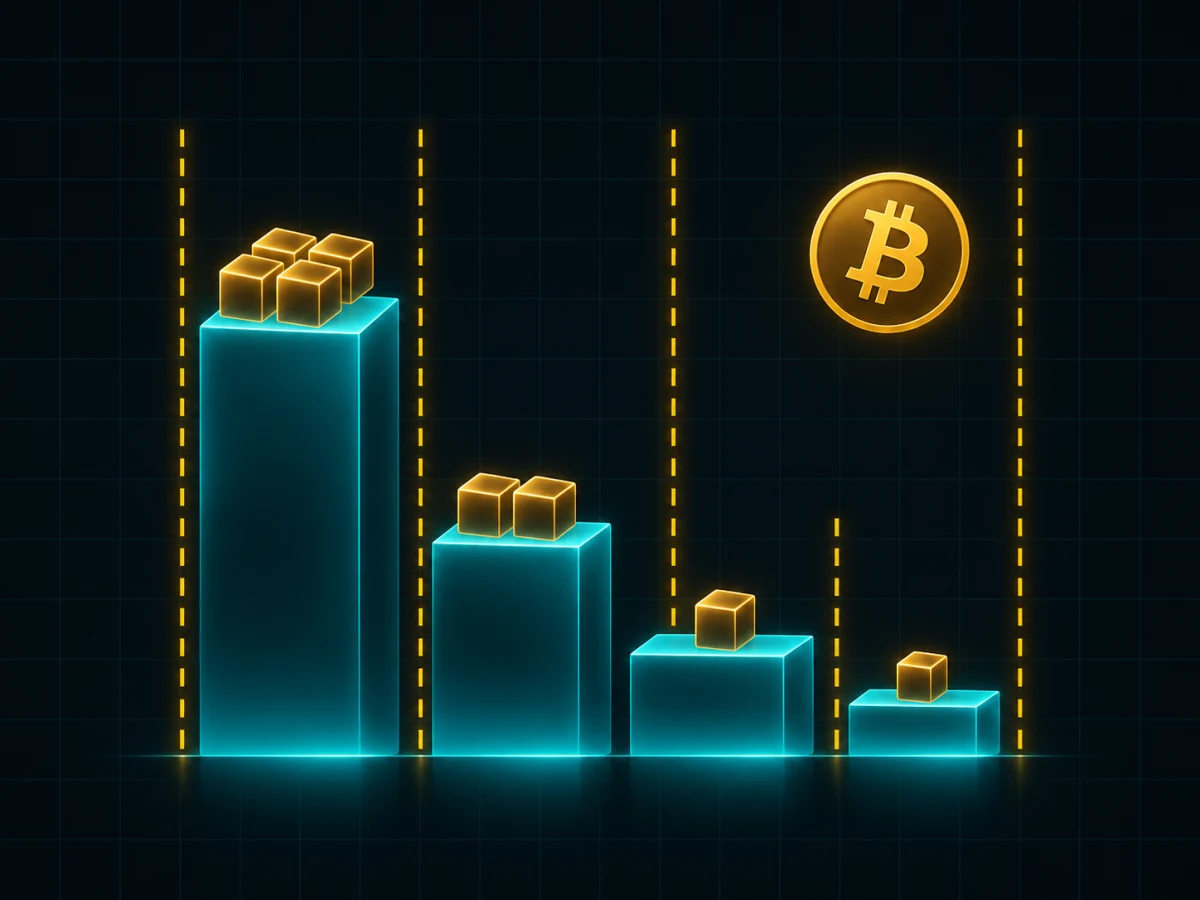
Illustrative subsidy model: assume a starting subsidy of 50 BTC and a divisor of 2 at each completed interval. The sequence is calculated as follows:
| Completed intervals | Calculation | Model subsidy |
|---|---|---|
| one | 50 / 2 | 25 BTC |
| two | 50 / 4 | 12.5 BTC |
| three | 50 / 8 | 6.25 BTC |
| four | 50 / 16 | 3.125 BTC |
This table explains the arithmetic only. It is not a live chain-status claim and it is not a price model.
03What a halving changes#
- New issuance per block falls according to the subsidy rule.
- The same block-height rule applies to every participant validating the chain.
- Miner revenue pressure can change. Each miner's result still depends on fees, energy cost, equipment efficiency and its share of produced blocks.
04What it does not determine#
- Market demand. Fewer new coins do not force buyers to bid at a particular price.
- The calendar date in advance. The block height is exact; a date estimate depends on future block production.
- Transaction fees. Fees and subsidy are distinct parts of a block reward.
- A profitable trade. Entry price, leverage, liquidity and holding period can dominate the issuance change.
05A better way to read halving forecasts#
When an article or chart claims a post-halving target, ask four questions:
- Is the claim describing the protocol or forecasting a market outcome?
- Which demand assumption turns lower issuance into the stated price?
- Does the comparison account for changing liquidity and market structure?
- What observation would prove the forecast wrong?
Without those answers, a historical chart is a story rather than a reproducible model. A small number of past events cannot establish a mechanical price law.
06Practical checklist#
For a long-term holder, custody and recovery planning matter regardless of the subsidy schedule. Review the hot versus cold wallet trade-off and keep the seed phrase recovery process separate from the device.
For a trader, define loss tolerance before choosing leverage. The sequence in risk per trade is more actionable than treating a protocol event as an entry instruction.
Finally, label every number correctly. A block interval read from consensus code is a protocol fact. A calendar date is an estimate. A price target is a model. Combining all three under the word "halving" hides the most important difference: only the first is enforced by the network.
07Primary code references#
FAQ#
What is the Bitcoin halving?
Who decides when Bitcoin halves?
Does a halving make Bitcoin price rise?
Why can the estimated halving date move?
What should an investor check around a halving?

DoberInvest on Telegram
Questions about this guide?Ask in the English channel. That is also where we post charts, the levels we watch and what would change our mind. A system, not signals, and no profit promises.
This guide explains how the mechanics work; what you do with them is your own decision. Trading can lose you money, and leverage makes losses bigger and faster. 18+

Founder of DoberInvest, in the market since 2018. Teaches a system, not signals.