




In this guide 8
Exchanges charge two fees for the same trade. Makers place orders that rest in the order book and wait; they pay the lower fee. Takers fill against orders already in the book; they pay the higher one. On BingX perpetual futures the base rates are 0.02% maker and 0.05% taker. The catch: a limit order does not make you a maker by itself. Only an order that actually rests in the book does.
01The order book is the product#
Picture the order book as a shop with two kinds of visitors.
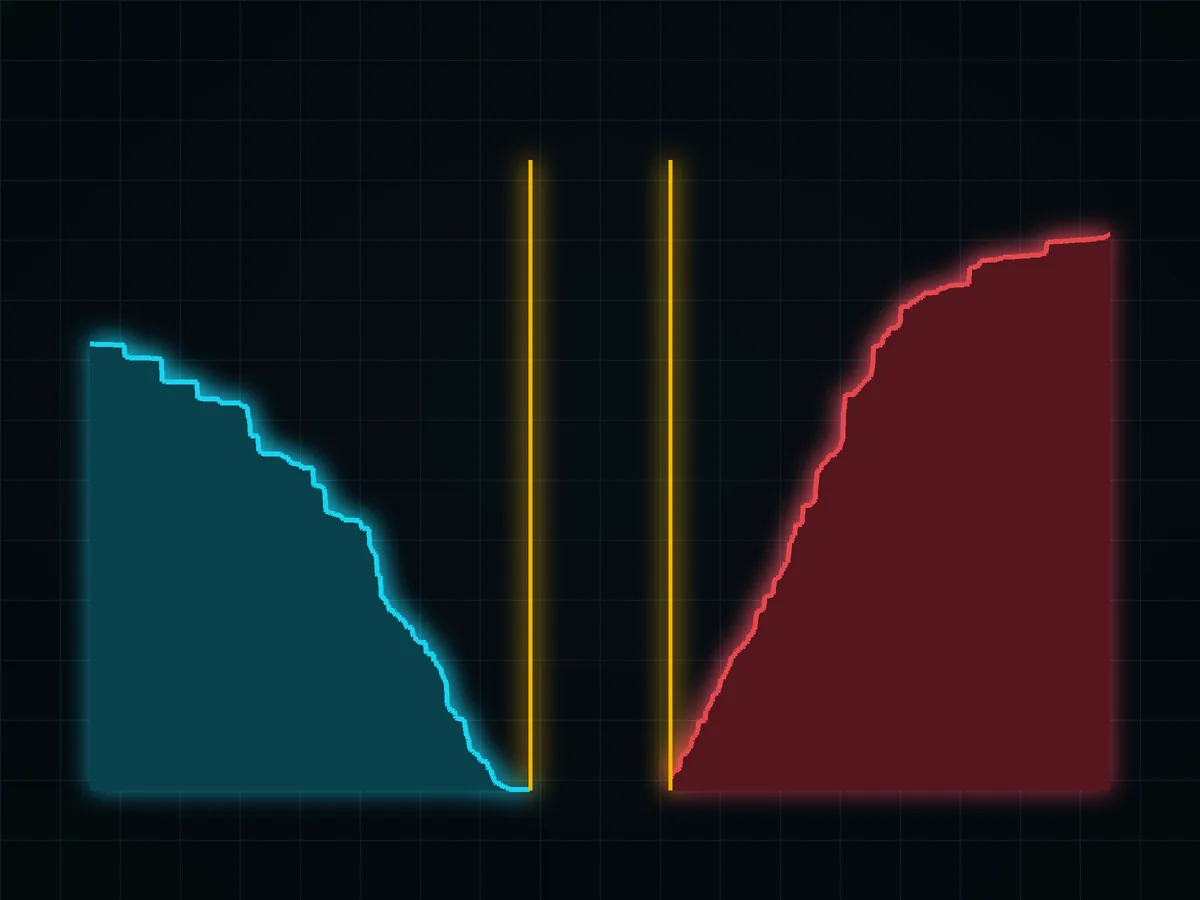
A maker ("makes the market") posts an order that does not fill right away. It sits in the book and waits for someone on the other side. While it waits, the book is deeper.
A taker ("takes liquidity") fills against what is already in the book. The order executes instantly because a buyer or seller is already standing there.
The exchange's logic is almost embarrassingly simple. A deep book is the reason traders come: more resting orders mean less slippage and better fills. Makers produce that product. Takers consume it. So makers get a discount, takers pay a markup, and on some venues and tiers the exchange even pays makers a small rebate.
02The trap: a limit order does not make you a maker#
This is where most people go wrong, and it costs them money every day.
The common belief is "market order means taker, limit order means maker." The first half is always true. The second half is false.
What makes you a maker is one fact: did your order rest in the book, or did it fill immediately?
Say the best offer is 102. You place a limit buy:
- at 101: it rests in the book and waits. You are a maker.
- at 102: a seller is already waiting at that price. The trade happens instantly. You are a taker, even though it was a limit order.
So you can pay the taker rate with limit orders all day without noticing. The fill comes at the price you named and everything looks right. The difference shows only in the fee column.
03Post-only: the switch that settles it#
Almost every exchange has a post-only option on limit orders (sometimes called "maker only"). It means: if this order would fill immediately, do not fill it, cancel it.
That changes the nature of the order. Without the flag, the exchange fills it however it can and charges whatever fee results. With the flag the rule is firm: either a fill at the maker rate, or no fill at all.
The price of that certainty is the occasional cancellation. If the market moves away, the order is cancelled and you have to place it again. For an entry that can wait, that is a fair trade. For an exit from a losing position, it is not, as explained below.
04What it costs in a year#
Take $240,000 of trading volume a year, about $20,000 a month. That is ordinary for someone who trades regularly without leverage.
At BingX's base perpetual futures rates of 0.02% maker and 0.05% taker:
| Yearly volume | All maker | All taker | Difference |
|---|---|---|---|
| $240,000 | $48 | $120 | $72 |
| $2,400,000 | $480 | $1,200 | $720 |
At $72 a year it is not worth breaking your trading over. But an active trader using leverage easily turns over ten times more volume with the same account, and the same percentages become $720 a year. Same trades, same market result. The difference is a checkbox in the order window.
05When being a taker is the right call#
From all of the above it is easy to conclude "always use limit orders and wait." That is a bad conclusion.
The taker is not paying a fine. The taker pays for speed and a certain fill, and sometimes that is the cheapest thing you can buy:
- Exiting a losing position. A few hundredths of a percent are nothing next to another hour in a trade that is going against you.
- Entering on an event. If the idea depends on a move that has already started, an unfilled order at a pretty price is not a saving. It is a missed trade.
- A thin order book. On an illiquid pair, waiting in the book can cost more than the fee while price walks away.
The right rule is not "maker is better." It is: speed has a price, so pay it on purpose. Being a taker is fine. Being a taker by default, without ever thinking about it, is the problem.
06How to pay less without hurting your trading#
Five levers, from the biggest effect down:
- Limit orders where the trade can wait. This moves you from the taker rate to the maker rate, cutting the fee by a factor of 2.5 at the BingX base rates.
- Post-only on entries. A safety catch, so you never drift into the taker rate by accident.
- Your fee tier. It usually depends on 30-day volume or on account balance, and the second can be reached without a single trade.
- Compare spot and futures fees for frequent trading. If your exchange charges more on spot, futures look cheaper per trade. But futures carry liquidation risk that spot does not, so this is not only a fee decision.
- Fewer trades. The dullest lever and the most effective: the fee is charged on every trade, and overtrading costs more than any rate.
07Do this today#
- Open your exchange's fee schedule and find the two columns, maker and taker. See what you actually pay and how far apart they are.
- Open your trade history and check which rate each fill was charged at. Many traders discover they are takers almost all the time.
- Find the post-only checkbox in the order window and remember where it is, so that it is a choice and not an accident.
FAQ#
Is a limit order always a maker order?
How do I make sure I pay the maker fee?
Why do exchanges give makers a discount?
How big is the difference in practice?
Is paying the taker fee always a mistake?

DoberInvest on Telegram
Questions about this guide?Ask in the English channel. That is also where we post charts, the levels we watch and what would change our mind. A system, not signals, and no profit promises.
This guide explains how the mechanics work; what you do with them is your own decision. Trading can lose you money, and leverage makes losses bigger and faster. 18+

Founder of DoberInvest, in the market since 2018. Teaches a system, not signals.