




In this guide 7
Slippage is the gap between the price you saw when you clicked and the average price you were actually filled at. A market order fills against the order book level by level, and when your size is bigger than what waits at the best price, each next level costs more. Your fee report never shows it: the cost is already inside the fill price. On a liquid pair it is tiny; on a thin one it can dwarf the trading fee.
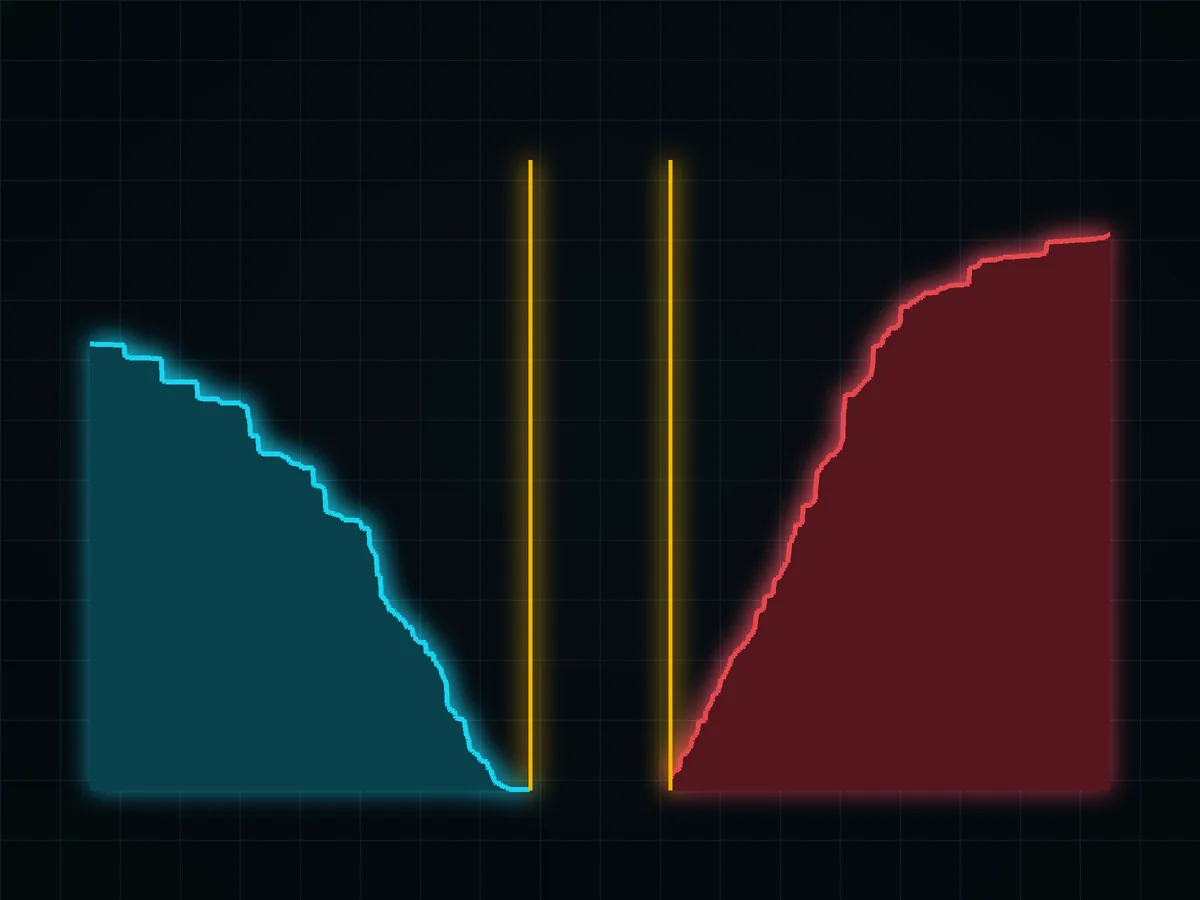
01The order book is finite, and a market order eats it in layers#
You buy 1 BTC with a market order at a screen price of 102 (round numbers for clarity). Only 0.5 BTC is offered at 102, so that is not enough. The exchange takes what is there and moves up:
- 0.5 BTC at 102
- 0.3 BTC at 103
- 0.2 BTC at 104
Average fill: 102.70. You saw 102 and paid 102.70. That is 0.70 per coin, or about 0.69% of the trade.
For comparison, a 0.05% taker fee on the same trade is almost fourteen times smaller than that invisible cost.
The key point: the price on the screen is the price of the first level, not the price of your size. The larger your order relative to the depth of the book, the further apart those two numbers get.
02What it cost on real order books#
Numbers on paper are one thing. Here is what a market buy would have cost on BingX order books on October 22, 2026, at 20:44 UTC, measured as the average fill against the best ask at that moment:
| Market | $10,000 buy | $100,000 buy | $1,000,000 buy |
|---|---|---|---|
| BTC-USDT spot | 0.003% | 0.010% | 0.026% |
| NEAR-USDT spot | 0.055% | 0.104% | 1.38% |
| ONDO-USDT spot | under 0.001% | 0.139% | about 11.6% |
| BTC-USDT perpetual | under 0.001% | 0.003% | 0.007% |
Read the last column. A million-dollar market buy of Bitcoin costs a few hundredths of a percent. The same order on ONDO spot walks through most of the visible book and pays more than a tenth of its value in slippage. The fee rate is identical in both cases. The cost of entry is not.
Note the perpetual row too: on this snapshot the Bitcoin perpetual book was far deeper than spot. Depth differs between spot and futures on the same exchange, so check the one you actually trade.
03Why it never appears in any report#
A fee is a separate operation. It is deducted and listed as a line. Slippage is not an operation at all. It is simply the price you were filled at.
That gives it an unpleasant property: you cannot notice it unless you look for it. You open your history, see "bought at 102.70", and there is nothing to compare it with. You no longer remember the screen said 102. The cost is real; the trace is gone.
The only way to see it is to measure: compare the price when you sent the order with the average fill price.
04What makes slippage worse#
- Order size relative to the book. The main factor. The same size is harmless on Bitcoin and painful on a thin altcoin.
- News releases. In the first seconds after a data release market makers pull their orders, the book thins out, and a market order falls deeper than usual.
- Nights and weekends. Fewer participants, thinner books.
- Market stop-losses. A stop fires exactly when price moves fast, which is the worst moment for a fill. Almost nobody thinks about this when placing one. The same is true of liquidations, which close at market at the worst time.
05How to reduce it#
Limit orders. You will not be filled worse than your price, so the price question is closed. In return you take on the risk of no fill: the order can sit in the book and never execute. It is the same fork as in maker vs taker fees: you pay either in price or in the chance of execution. There is no third option.
Choose the pair. Trade where the book is deep. The most effective decision and the most ignored one.
Split the order. Break a large order into parts and feed it in gradually, so the book has time to refill between pieces. Built-in algorithms such as TWAP work on the same principle.
Do not enter in the first seconds after news. The move will still be there, and the book will have recovered.
06Measure your own slippage today#
- Take your last five trades. For each, compare the price when you sent the order with the average fill price. Work out the percentage: (fill − screen price) ÷ screen price.
- Compare the result with your fee rate. Many traders find they were saving on the wrong thing.
- Look at the depth of the order book on your pair at the time of day you usually trade.
Fees and slippage are the cost of getting in. There is also the cost of staying in: on futures it is charged at every funding settlement. That is in funding rate explained.
FAQ#
What is slippage in crypto?
Why does slippage not show up in my trade report?
Can slippage be in my favor?
Does a limit order remove slippage?
What is worse, fees or slippage?

DoberInvest on Telegram
Questions about this guide?Ask in the English channel. That is also where we post charts, the levels we watch and what would change our mind. A system, not signals, and no profit promises.
This guide explains how the mechanics work; what you do with them is your own decision. Trading can lose you money, and leverage makes losses bigger and faster. 18+

Founder of DoberInvest, in the market since 2018. Teaches a system, not signals.