




In this guide 7
The liquidation price is the level at which the exchange force-closes your leveraged position because the collateral left in it is too small. For an isolated long the simple version is: entry × (1 − 1/leverage) ÷ (1 − maintenance margin rate). At 10x that is roughly 9.5% below your entry. The real level sits a little closer, it is checked against the mark price rather than the chart, and it creeps toward the market while you hold.
01Margin call vs liquidation#
They are not the same thing.
- A margin call is a warning: your collateral is low, add funds or reduce the position.
- Liquidation is the forced close that follows if nothing changes.
In practice the gap between the two can be a few seconds, so treat the margin call as information, not as a plan.
02The formula, step by step#
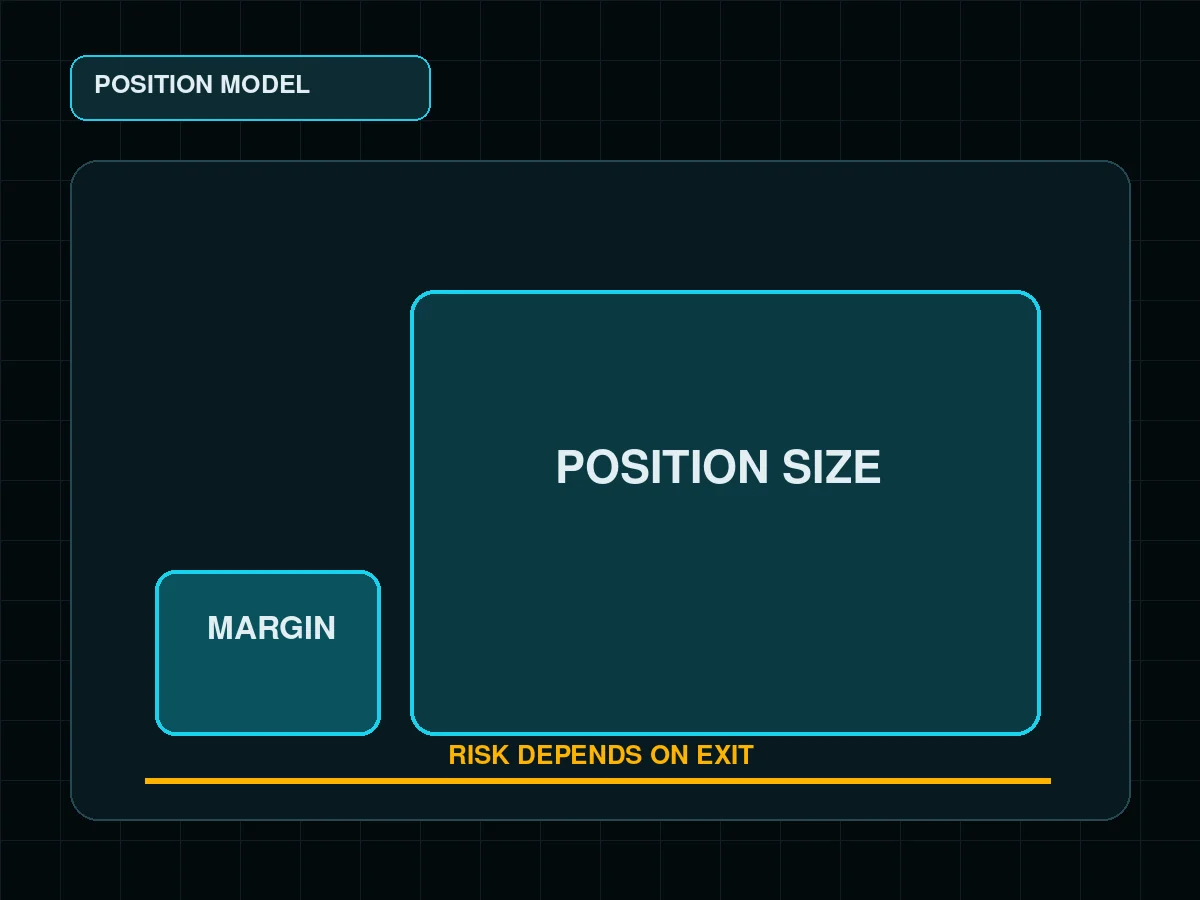
Take an isolated, USDT-margined long. You put up margin equal to position value divided by leverage. The exchange closes you when what is left of that margin falls to the maintenance margin, a minimum share of the position value set by the exchange.
Solve for that price and you get:
Long:  Entry × (1 − 1/L) ÷ (1 − MMR)
Short: Entry × (1 + 1/L) ÷ (1 + MMR)
L: leverage
MMR: maintenance margin rate
With an entry at 100 and a maintenance rate of 0.5% (a round number for illustration; your contract card shows the real one, and it grows with position size):
| Leverage | Long liquidated near | Room to liquidation | Short liquidated near |
|---|---|---|---|
| 2x | 50.25 | 49.7% | 149.25 |
| 5x | 80.40 | 19.6% | 119.40 |
| 10x | 90.45 | 9.6% | 109.45 |
| 20x | 95.48 | 4.5% | 104.48 |
| 50x | 98.49 | 1.5% | 101.49 |
Look at the 20x row. A move of about 4.5% is an ordinary day for most crypto assets. At that leverage a routine move takes you out, with no news and no crash required.
03It is measured against the mark price#
The chart shows the last price, the price of the last trade on your exchange. Liquidation on most large venues is checked against the mark price: a smoothed value built from an index of several spot exchanges.
There is a good reason. If liquidations used the last trade, someone could push a thin order book on one exchange and wipe out positions cheaply. Moving an index of several venues costs far more.
The side effect is familiar to anyone who has traded with leverage:
- A candle wicks right through your liquidation price and the position survives. The mark price never got there.
- Or the opposite: on the chart you still had room, and the position was closed. The mark price moved further than the last trade.
So when you judge how close you are, watch the mark price. It sits right next to your position in the interface.
04The buffer shrinks even when the price stands still#
Another common mistake is treating the liquidation price as fixed. It is set at entry and then worn down from three sides.
Loss on the position. The obvious one: the further price moves against you, the less margin is left.
Accumulated funding. It is taken from the same margin at every settlement. Example: a 10x long from 100 at a 0.5% maintenance rate starts with liquidation near 90.45. Hold it for a week while longs pay 0.05% per 8-hour period, and 21 settlements remove about 1.05 from the margin per unit. Liquidation moves to about 91.5. The price did not move, and about a ninth of your buffer is gone. The cost of funding is broken down in funding rate explained.
The maintenance margin itself. Because of it, liquidation comes before your margin hits zero. The back-of-the-envelope "10x means I can survive 10%" is always more optimistic than reality.
05Why liquidation is the most expensive exit#
When liquidation fires, the position is closed with a market order, immediately, at the moment the market is moving fast and the order book is thin. Those are the worst possible conditions for execution, so slippage is at its highest. On top of that, exchanges charge a fee for the forced close.
A stop-loss that you set before the liquidation level is almost always cheaper. The difference between "I exited with a loss" and "I got liquidated" is money, and the fact that after a stop you still have most of your capital.
06A working order of steps#
- Check the liquidation price before you enter, and compare the distance to it with the instrument's normal daily range. If it is closer than a normal day's move, the leverage is too high.
- Put your stop before it. Liquidation is the exchange's emergency brake, not your risk tool.
- Choose isolated or cross margin consciously. Cross margin moves liquidation further away by putting your whole balance on the line. See isolated vs cross margin.
- On a long hold, recheck the level. If it moved, funding took its share.
- Judge distance by the mark price, not by the candle.
Leverage is the last thing you pick, not the first. Start with how much you are willing to lose and where the idea is wrong; the position size follows from that, and the leverage only needs to keep liquidation safely beyond your stop. The math is in risk per trade.
Where this check fits among the other steps of a futures trade is shown in how to trade crypto futures.
FAQ#
How is the liquidation price calculated?
What is the difference between a margin call and liquidation?
Which price triggers liquidation?
Can I be liquidated if the price does not move?
What is the maintenance margin rate?

DoberInvest on Telegram
Questions about this guide?Ask in the English channel. That is also where we post charts, the levels we watch and what would change our mind. A system, not signals, and no profit promises.
This guide explains how the mechanics work; what you do with them is your own decision. Trading can lose you money, and leverage makes losses bigger and faster. 18+

Founder of DoberInvest, in the market since 2018. Teaches a system, not signals.