


In this guide 12
To trade crypto futures, you open a contract that follows a coin's price, go long if you expect a rise or short if you expect a fall, and post only part of the position value as margin. The order of work matters more than the button: pick the contract, size the position from your stop, choose leverage last, place entry and stop together, then count the full cost before you hold anything overnight.
This guide walks through those steps in order. Every mechanic gets a short explanation here and a full breakdown in its own article, so you can use this page as a map of the whole topic.
01What crypto futures are, in two minutes#
A futures contract is an agreement on the price of an asset, settled in money. You never hold the coin. You hold a position whose profit or loss follows the coin's price.
Crypto exchanges trade two kinds:
| Dated futures | Perpetual futures | |
|---|---|---|
| Expiry | Settle on a set day | Never expire |
| What keeps price near spot | Expiry itself | Funding payments between longs and shorts |
| Who uses them | Hedgers, basis traders, regulated venues | Most retail crypto trading |
| Hidden cost while holding | Rolling to the next contract | Funding, usually every 8 hours |
Most of what people call "crypto futures" today are perpetuals. The mechanics behind them are in perpetual futures explained, and if you are still choosing between owning coins and trading contracts, start with futures vs spot.
Two things make futures different from buying a coin:
- You can profit from a fall. A short is as easy to open as a long. How that works, and what it costs, is in how to short crypto.
- You trade with margin. You put up a fraction of the position, and the exchange can close you if that fraction runs out. That is leverage, and it is where most accounts get hurt.
02Step 1. Choose the contract and read its card#
Start with liquid contracts: BTC and ETH perpetuals, then the largest altcoins. Liquidity is not a detail. On a thin market the same order fills at a worse price, and the gap shows up in every exit.
Before the first trade, open the contract card and note four things:
- Settlement currency. USDT-margined contracts count profit, loss and margin in USDT. Coin-margined contracts count them in the coin, which adds a second price exposure.
- Fees. On BingX perpetuals the standard rates were 0.02% for maker orders and 0.05% for taker orders on October 23, 2026. They are charged on the full position value, not on your margin. More in maker vs taker fees.
- Funding schedule. The BTC-USDT perpetual on BingX settles funding every 8 hours. If your position is open at the settlement moment, you pay or receive. See funding rate explained.
- Minimum order. On the same contract it was 0.0001 BTC, about $8 at the price that day. The minimum is never the constraint. Your risk is.
03Step 2. Size the position from your stop, not from your balance#
This is the step most beginners skip, and the one that decides whether a bad week is a dent or the end of the account.
Work backward:
- Decide how much of the account you accept losing on this idea. A common working number is 1%.
- Find the price where the idea is wrong. That is your stop. How to pick it is in where to place a stop-loss.
- Divide.
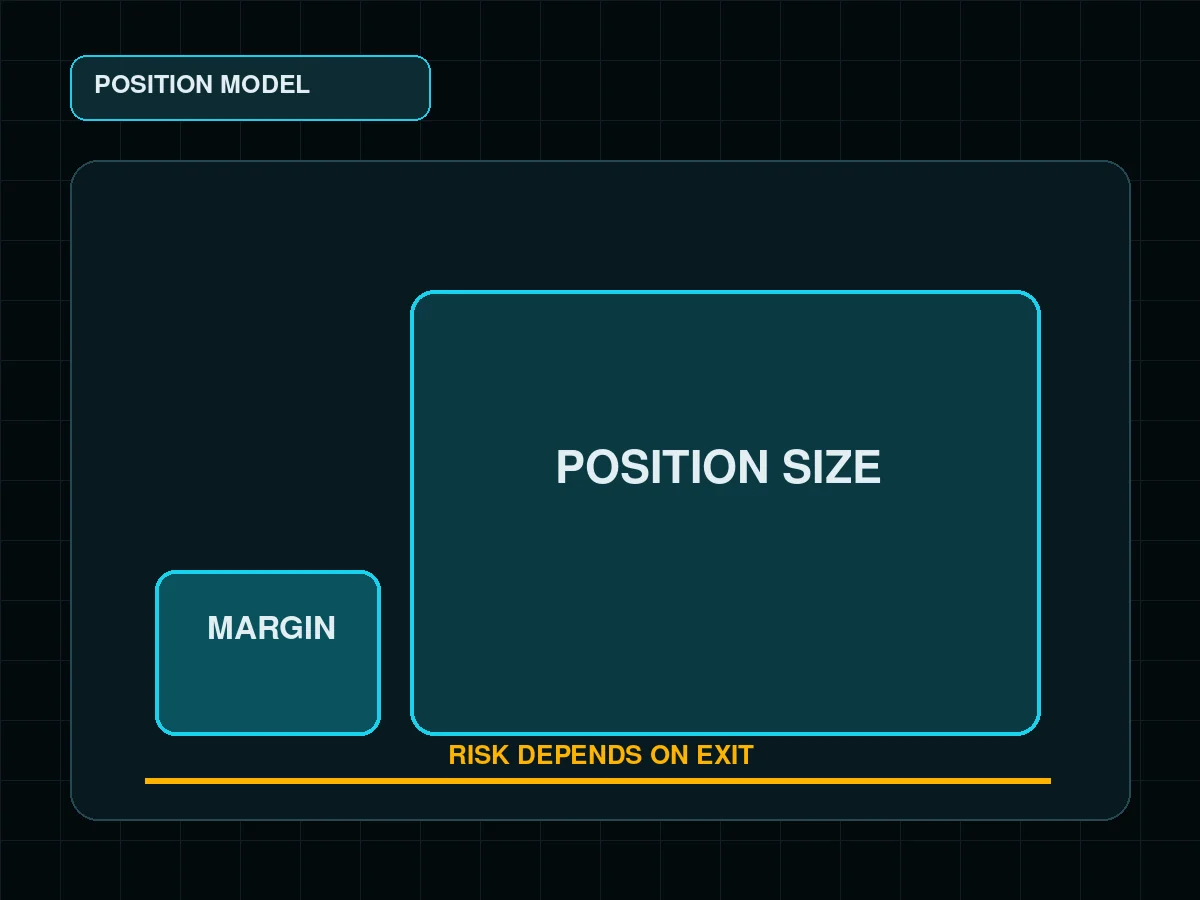
Position size = (Account × Risk %) ÷ Stop distance %
A $10,000 account, 1% risk ($100) and a stop 4% away give a $2,500 position. That number does not depend on leverage at all. The full method, with tables for losing streaks, is in risk per trade.
04Step 3. Choose margin mode and leverage last#
Leverage only decides how much margin you post for the position you already sized. The same $2,500 position needs $500 of margin at 5x and $250 at 10x. The risk to your account is the same $100 if the stop works.
What leverage changes is where liquidation sits. With a 0.5% maintenance margin rate (an illustrative round number):
| Leverage | Liquidation distance for a long | Same-day liquidations of a BTC long opened at the daily open, last 365 days |
|---|---|---|
| 2x | 49.8% | 0 |
| 5x | 19.6% | 0 |
| 10x | 9.6% | 2 |
| 20x | 4.5% | 22 |
| 50x | 1.5% | 158 |
The last column is our count on 365 daily BTC candles, October 23, 2025 to October 22, 2026. At 20x, an ordinary bad day was enough 22 times in one year.
With a 4% stop, anything above about 22x puts liquidation before the stop, and the stop never gets the chance to work. Rule of thumb: liquidation must sit well beyond your stop, with room to spare.
Margin mode matters as much. Isolated margin limits the loss to what you posted on that trade. Cross margin pushes liquidation further away by putting your whole balance behind every position. Start with isolated; the trade-offs are in isolated vs cross margin, and the formula behind the table is in liquidation price.
05Step 4. Place the entry and the stop together#
A futures position without a stop is a bet that the exchange's liquidation engine will be your exit. It is the most expensive exit there is.
The order types you will use:
- Limit order. You name the price. If it rests in the book, you pay the maker fee.
- Market order. Fills now at whatever the book offers, at the taker fee, with slippage on thin markets.
- Stop-market. Becomes a market order when the trigger is hit. It gets you out, at an uncertain price.
- Stop-limit. Becomes a limit order when triggered. You control the price, but in a fast move it may not fill. When to use which is in stop-limit order explained.
Most terminals let you attach the stop and take-profit to the entry order. Do it there, so the position never exists without protection, even for a minute.
06Step 5. Count the full cost before you hold#
Here is a real example. $1,000 of margin, 5x, a $5,000 long on the BingX BTC-USDT perpetual, held for three days (nine funding settlements), entered and exited with market orders.
| Cost item | How it is counted | Amount |
|---|---|---|
| Taker fee, entry and exit | 0.05% × $5,000 × 2 | $5.00 |
| Funding, nine settlements at the year's average rate | 9 × 0.0039% × $5,000 | $1.73 |
| Slippage on a $5,000 market order, both sides | BTC order book on October 23, 2026 | about $0.02 |
| Total | $6.75 |
That is 0.68% of your margin, and BTC has to move about 0.14% in your favor just to get back to zero.
Where the numbers come from: the 0.0039% is the average of 1,000 funding settlements on that contract, November 24, 2025 to October 23, 2026. Longs paid shorts in 78.6% of them, and the highest rate in the period was 0.0100% per settlement. At that rate the same three days cost $4.50 in funding instead of $1.73.
Three things move this total:
- Limit orders. Entering and exiting as maker cuts the fee line from $5.00 to $2.00.
- The coin. On BTC slippage is a rounding error. On a thin altcoin it is not: the same $5,000 market sell on ONDO-USDT would have lost about $1.15 to slippage on that day's book, each way.
- Time. Fees are paid once. Funding is paid every 8 hours for as long as you hold.
07Step 6. Manage the position while it is open#
Once the trade is on, your job is narrow:
- Recheck liquidation on longer holds. Funding comes out of your margin, so the liquidation price drifts toward the market even on a flat chart.
- Watch settlement times, not hours. Closing one minute before a settlement saves a full funding period; one minute after costs it.
- Move the stop only toward profit. Widening a stop because the price is close is how a 1% loss becomes a 5% loss.
- Do not add margin to a losing trade by reflex. Topping up isolated margin pushes liquidation away and raises the amount you can lose on the same idea.
08Step 7. Close the trade and write it down#
When the stop or target is hit, the trade is done. Write down the entry, exit, size, fees, funding paid or received, and why you took it. After 30 trades your journal will tell you more about your edge than any indicator. A template and the math of win rate against reward-to-risk are in the trading journal guide.
09How much money do you need to start?#
Technically, about $8 on a BTC perpetual at the October 23 price. Practically, enough that 1% of the account is a meaningful amount for you and that fees do not eat the whole edge. Many traders start with an amount they are fully prepared to lose while learning, and keep it small until the journal shows a positive result over dozens of trades.
10Can you trade crypto futures on weekends?#
Yes. Perpetuals trade 24/7 and funding keeps settling on weekends. What changes is the market: fewer participants and thinner books mean a single large order moves price further. If you hold over a weekend, the stop matters more.
11The mistakes that end accounts#
- Choosing leverage first. The position grows to fit the margin instead of the risk.
- No stop, "I'll watch it". Nobody watches a screen 24/7, and crypto does not close.
- Ignoring funding on long holds. A small rate on the full position becomes a large share of the margin.
- Averaging down on margin. Each add moves liquidation closer.
- Market orders on thin coins. Slippage turns a planned 1% loss into 1.5%.
Futures are a tool for expressing a view with less capital tied up, and for going short. They do not change the odds of the idea. Size from risk, pick leverage last, count costs, keep the stop on. That order is the whole method.
FAQ#
How does crypto futures trading work?
Do crypto futures expire?
How much money do you need to trade crypto futures?
Can you trade crypto futures on the weekend?
Is crypto futures trading profitable?
What leverage should a beginner use for crypto futures?

DoberInvest on Telegram
Questions about this guide?Ask in the English channel. That is also where we post charts, the levels we watch and what would change our mind. A system, not signals, and no profit promises.
This guide explains how the mechanics work; what you do with them is your own decision. Trading can lose you money, and leverage makes losses bigger and faster. 18+

Founder of DoberInvest, in the market since 2018. Teaches a system, not signals.