



In this guide 7
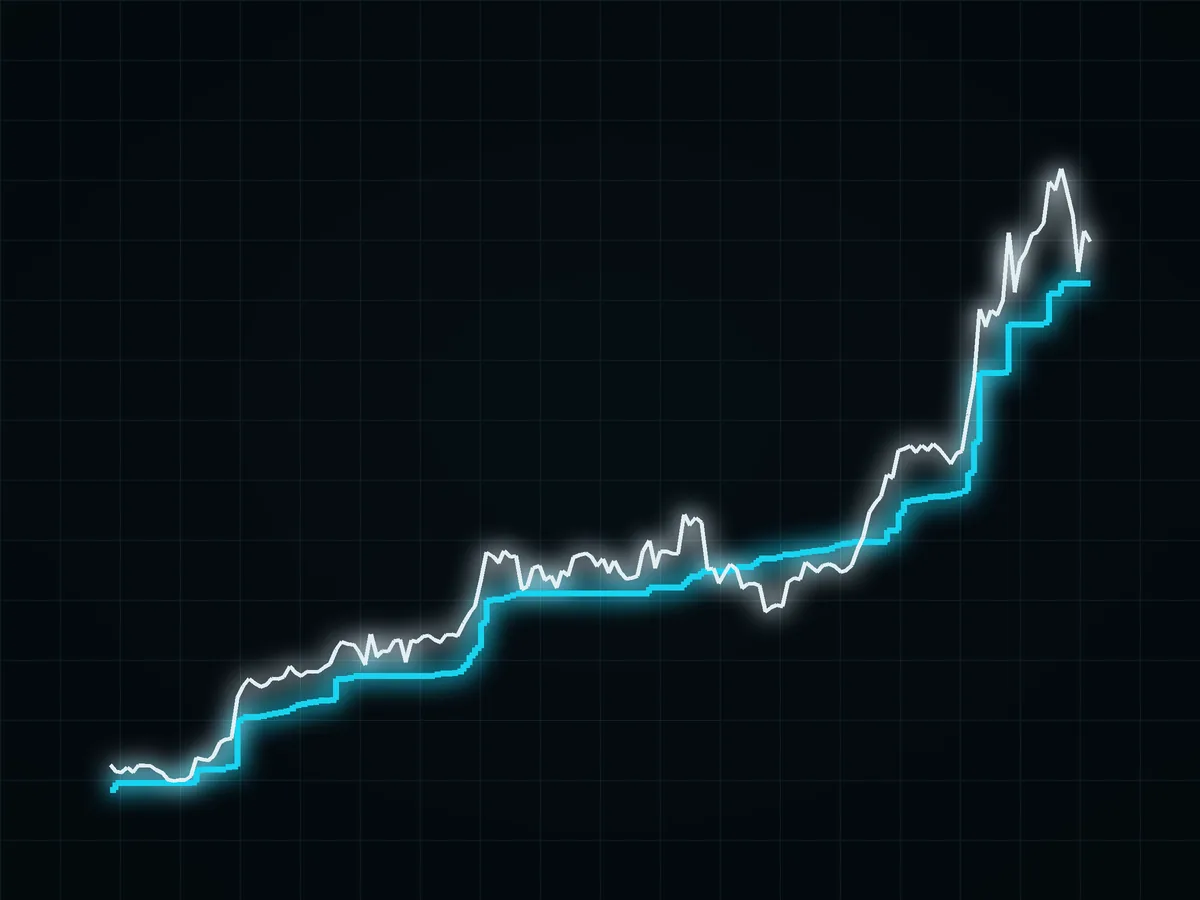
A trailing stop loss is a stop that follows the price. You set a distance, for example 10%. As the price climbs, the stop climbs with it and always stays 10% below the highest price so far. When the price falls, the stop does not move back down. If the price drops the full 10% from its peak, the stop triggers and closes the position, usually with a market order.
The whole question is the width. Too tight, and an ordinary pullback throws you out of a trend. Too wide, and you hand back a large part of the gain before the exit. So we tested five widths on real BTC and SOL history, and the result is less obvious than most guides suggest.
01How a trailing stop moves, step by step#
You buy at 100 with a 10% trail:
| Price moves to | Highest price so far | Stop level | What happens |
|---|---|---|---|
| 100 | 100 | 90 | Stop set |
| 115 | 115 | 103.5 | Stop moved up, profit now partly protected |
| 108 | 115 | 103.5 | Stop stays put |
| 130 | 130 | 117 | Stop moved up again |
| 117 | 130 | 117 | Triggered, position closed near 117 |
You never sold at 130, the top. You sold about 10% below it. A trailing stop does not find tops; it decides in advance how much of the move you are willing to give back.
02On exchanges: callback rate and activation price#
Crypto exchanges usually offer it as a separate order type, often called a trailing stop or trailing stop market order. Two settings matter:
- Callback rate. The trail distance in percent. On Binance Futures, for example, it accepts values from 0.1% to 10%. If you want a wider trail than the exchange allows, you have to move an ordinary stop by hand.
- Activation price. Optional. The trail only starts once the price reaches this level. Without it, the trail starts from the price at the moment you place the order.
Most trailing stops close with a market order, so the fill can come in below the trigger in a fast drop. On a position with leverage, check that the starting stop level sits well before the liquidation price; see liquidation price explained.
03We tested five widths on BTC and SOL#
The setup is simple and repeatable. Buy at the daily close on the first day of every month. Trail the stop from the highest high since entry. Exit when a daily low touches the stop (at the stop, or at the open if the day opened below it). BTC from January 2019, SOL from January 2021, daily candles to October 22, 2026. Two kinds of trail: a fixed percentage, and a multiple of the 14-day ATR, a measure of how much the coin usually moves in a day.
BTC, 94 entries since 2019 (89-94 closed trades, depending on width):
| Trail | Trades in profit | Average result | Median result | Median days held | Best trade |
|---|---|---|---|---|---|
| 5% | 52% | +3.0% | +0.5% | 4 | +41.1% |
| 10% | 42% | +3.8% | -2.1% | 12 | +60.4% |
| 20% | 43% | +17.0% | -4.9% | 53 | +222.8% |
| 2× ATR | 49% | +2.9% | -0.3% | 10 | +53.9% |
| 3× ATR | 43% | +3.6% | -1.8% | 16 | +59.0% |
SOL, 70 entries since 2021:
| Trail | Trades in profit | Average result | Median result | Median days held | Best trade |
|---|---|---|---|---|---|
| 5% | 44% | +1.3% | -1.4% | 2 | +27.8% |
| 10% | 39% | +2.1% | -3.4% | 4 | +42.6% |
| 20% | 35% | +5.4% | -7.7% | 14 | +164.7% |
| 2× ATR | 41% | +3.3% | -3.3% | 9 | +113.0% |
| 3× ATR | 43% | +10.5% | -6.1% | 16 | +350.6% |
Look at the median column first. For most trail widths the typical trade lost a little. The average is positive only because a handful of trades caught a long run and the trail let them ride. That is the honest description of a trailing stop: many small exits, a few large wins.
What changes with width:
- Tighter trails win more often and hold for days. On BTC, the 5% trail ended in profit 52% of the time, with a median hold of 4 days, and never caught more than +41%.
- Wider trails lose more often and hold for weeks. The 20% trail on BTC was in profit only 43% of the time, but its best trade made +222.8%, and the average was the highest of all.
- SOL needed more room. Its 5% trail held for a median of 2 days: SOL's normal daily swing is close to that distance.
04How wide to set a trailing stop#
Start from how much the coin moves on an ordinary day. The 14-day ATR on the October 22, 2026 close:
| Coin | ATR, % of price | 2× ATR | 3× ATR |
|---|---|---|---|
| BTC | 2.7% | 5.4% | 8.1% |
| ETH | 4.1% | 8.1% | 12.2% |
| SOL | 4.6% | 9.1% | 13.7% |
| NEAR | 11.0% | 21.9% | 32.9% |
A 5% trail is 2 ATR on BTC and about 0.5 ATR on NEAR. On NEAR it is not a trailing stop, it is a coin flip on the next candle. Using an ATR multiple keeps the trail proportional to each coin's noise.
A practical order of decisions:
- Decide the job. Catching a long trend wants 3× ATR or wider. Locking in a short swing wants 1.5-2× ATR.
- Check the starting loss. The initial trail is also your first stop. Size the position so that hitting it costs about 1% of the account; see risk per trade.
- Consider an activation price. Let the trade move one ATR into profit first, then start trailing.
- Do not tighten it out of fear. Squeezing the trail after a good day is how the big trade turns into a small one.
How to pick the first stop level is in where to place a stop-loss.
05Trailing stop vs fixed take-profit#
A fixed take-profit closes at a target you set in advance. It wins more often and caps the upside. A trailing stop leaves the upside open and gives back part of every move. Many traders split the position: half with a take-profit and a stop loss, half with a trail. The trailing stop itself is a type of stop order; how stop orders fill in fast markets is in stop-limit order explained.
06Mistakes that make trailing stops look broken#
- Same percentage on every coin. 5% is wide for BTC on a calm week and tight for a small altcoin.
- Trailing from the first minute in a choppy market. In a range, the trail closes trades on noise. Use an activation price or a plain stop until the trend shows up.
- Expecting to sell near the top. By design you sell one trail-width below it.
- Forgetting it is a market order. In a crash it fills where the book is, not where the stop was. More in slippage.
The full futures workflow, from sizing to exit, is in how to trade crypto futures.
FAQ#
How does a trailing stop loss work?
How much should a trailing stop be?
Are trailing stops a good idea?
Can a trailing stop loss fail?
What is the activation price on a trailing stop?

DoberInvest on Telegram
Questions about this guide?Ask in the English channel. That is also where we post charts, the levels we watch and what would change our mind. A system, not signals, and no profit promises.
This guide explains how the mechanics work; what you do with them is your own decision. Trading can lose you money, and leverage makes losses bigger and faster. 18+

Founder of DoberInvest, in the market since 2018. Teaches a system, not signals.